
Nowadays, (local) heritage is something we appreciate, celebrate, and nurture. We are paying increasing attention to preserving local sites, traditions, costumes, music, literature, collective memory, landscape, and even identity. We’re trying to keep a vivid memory of people who contributed to our community. But have you ever wondered when people started spotting heritage?
Peace and Home life

Georg Friedrich Kersting, Embroiderer by the window, 1817, National Museum in Warsaw, public domain, source: cyfrowe.mnw.art.pl
Let’s go back to the end of the eighteenth century. Europe was torn by long-lasting wars and conflicts. People had to abandon their homes, and families were mourning their beloved who had died on the battlefield. And one day it was all over. In 1815, the Vienna Congress resulted in setting up a new (political) order after years of Napoleonic wars.
Life was slowly coming back to normal, however, under some liberty-limiting conditions. Many families were reunited, and some finally found consolation and relief. People valued family life most, enlarged by a circle of close friends. They tried not to engage in any politics and enjoyed spending time in the cosy interiors of their comfortably furnished houses. A new art style was born, called Biedermeier. It was especially evident in interior design – sofas, chairs, numerous tables, and other furniture that served the comfort of residents and their guests.
People of that time appreciated taking tours and enjoying what their area had to offer – ruins, unusual plants, and giant trees. It was also a time of quick industrial development with a new social class, the bourgeoisie, who could now afford to take long-distance journeys.
Romantics and Past
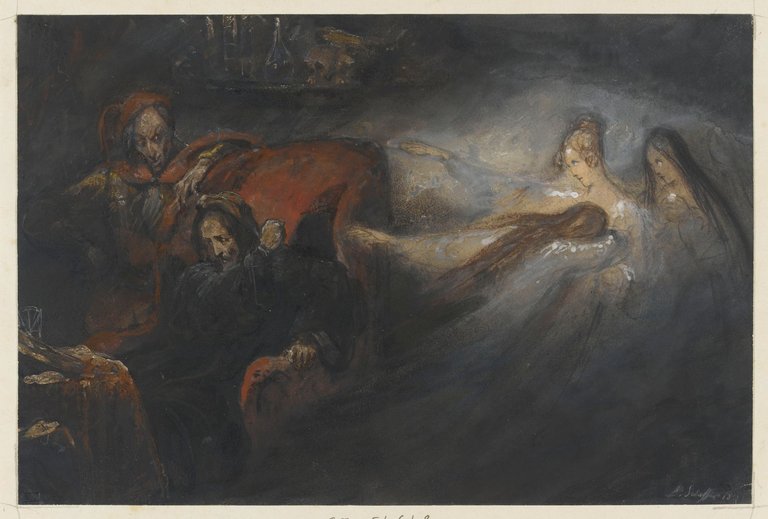
Ary Scheffer, Faust in his study, Mephistopheles, and three female ghosts, 1830, Muséé du Louvre, © GrandPalaisRmn (Musée du Louvre) / Thierry Le Mage, source: collections.louvre.fr
At the very same time, a new intellectual and artistic movement, Romanticism, was developing. Romantics noticed and appreciated the charm of not only great classical sites like Rome or Paris. They enjoyed discovering the intimate landscape of the area and its historical and sentimental value. They turned their eyes to the past as well, especially interested in the Middle Ages. Poets, musicians, painters, and other artists plunged themselves into folklore, local traditions, beliefs, and legends, drawing inspiration from them. This rediscovery brought to light and contributed to the development of the idea of shared cultural identity and a nation’s self-recognition.
Heritage state-recognised
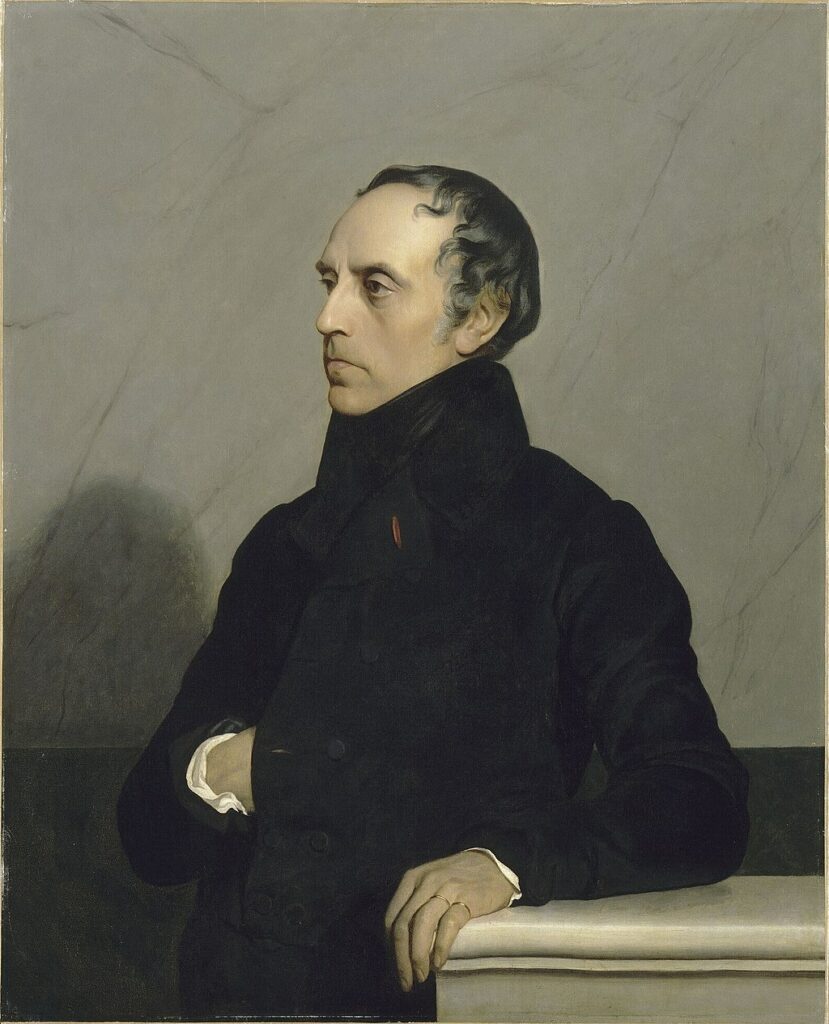
Jean Georges Vibert after Paul Delaroche, FRANÇOIS-PIERRE-GUILLAUME Guizot, app. 1837, public domain, source: commons.wikimedia.org

François Guizot, a French politician and historian, believed that ‘history could be a powerful force of social cohesion and sustain a need for national pride by illustrating the importance of France’s past’. [1] When he joined the French government in August 1830, he wanted to strengthen the legitimacy of the new regime by presenting it as a continuity of the national history. A few months later, in October 1830, he created a new position, the General Inspector of Historical Monuments [Fr. Inspecteur général des monuments historiques]. His role was to travel around France and collect information about all important and historical sites and monuments.
A few years later, in 1833, Guizot initiated the creation of the first historical organisation, called simply the French Historical Society [FR. La Société de l’histoire de France] whose goal was to popularise ‘the study and appreciation of our national history through healthy criticism and particularly through research and the use of original documents’.[2] Set up almost 200 years ago, it still exists, and its activities include publishing historical works and organising historical conferences.
This brief sketch aimed to highlight that heritage, and local heritage in particular, was (re)discovered by middle-class, intellectual, and artistic circles and by state authorities at the beginning of the 19th century. And although their motivations varied, and it would be an abuse to say that they defined it and preserved it as we do today, it is evident that this epoch played a significant role in shaping the idea of heritage.
[1] François Guizot – The heritage policy, accessed on 25 November 2025.
[2] Société de l’histoire de France – website, accessed on 25 November 2025.
Resources
François Guizot – The heritage policy, accessed on 25 November 2025.
Dominique Poulot, The birth of Heritage: ‘le moment Guizot’, accessed on 25 November 2025.
Société de l’histoire de France – website, accessed on 25 November 2025.