
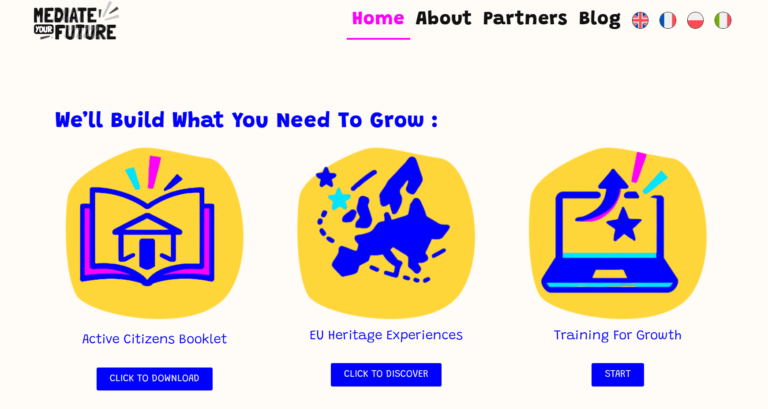
Mediate your future website – screenshot
Launching a project, whether entrepreneurial, community-based, or civic, requires far more than just a good idea. It demands the ability to unite a team, manage diverse personalities, navigate uncertainty, and overcome disagreements. This is precisely where mediation comes into play: not merely as a crisis management tool, but as a means to bring one’s ambitions to fruition.
The Erasmus+ “Mediate Your Future” project provides young people, educators, and project leaders with a range of free resources designed to develop these key skills (soft skills) and facilitate the transition to action.
Adopting a mediator’s mindset is essential when creating a project; when launching an initiative, obstacles are not always technical or financial; they are very often human. Integrating mediation methods from the design phase offers three major benefits:
- Clarify the shared vision: mediation fosters listening to the genuine needs of each stakeholder (team members, partners, beneficiaries) in order to build a solid, aligned project.
- Prevent team roadblocks: by fostering a culture of open dialogue and active listening, daily tensions are defused before they become obstacles.
- Strengthen relational leadership: a capable project leader knows how to make tough decisions, but a great project leader knows how to reconcile different viewpoints to build lasting engagement.

Team of youth, photo source PxHere
The resources developed by the five European partners as part of the project were designed to be practical and accessible. They enable progressive learning, tailored to each individual’s pace.
You will find…
- …training modules and practical guides
This theoretical and illustrated content will enable you to master the fundamentals, such as:
- Understanding conflict dynamics and communication biases.
- Techniques for rephrasing and empathetic listening.
- The distinction between:
- Positions, that is, what the partner says they want (an often rigid, stated demand)
- and interests, that is, why he wants it (motivations and fears, which are often negotiable and flexible).
- …case studies and practical scenarios
Nothing beats hands-on practice. Real-world scenarios allow you to confront actual situations—such as disagreements over budget allocation, divergent visions within the team, or engagement issues—and experiment with constructive solutions.
- …methodological guides for structuring one’s project
The resources directly link mediation to the project creation process: how to draft a team charter, establish shared governance rules, and design projects with high social impact.

Young people in the office, photo by PxHere
To move from learning to action; fully leverage these resources and launch your initiative, here is the step-by-step approach:
- Self-assess your skills: identify your communication strengths and areas for improvement using the diagnostic tools available on the site.
- Form your core team: share the modules with your future partners or teammates so you can adopt a shared language and common instincts from day one.
- Apply the methodologies to your project: use the facilitation guides to lead your first brainstorming workshops and formalize your organization’s operations.
- Leverage these skills: the competencies acquired in mediation and project management are highly valuable on a CV or through Europass and Youthpass certifications.
In short, this project offers a springboard for future changemakers. Access to free, high-quality resources grounded in the realities of young people provides an opportunity to bring meaningful ideas to life. By embracing the tools offered by Mediate Your Future, you do more than just develop a technical skill; you cultivate the mindset needed to build projects that are human-centric, resilient, and purposeful.
Sources and references
- Mediate Your Future Project — Platform for resources, modules, and practical guides.
- European Commission — European Entrepreneurship Competence Framework (EntreComp). Emphasis on problem-solving and teamwork .
- Youthpass Official Resource — Learning and Recognition in Erasmus+ Youth Projects.
- Harvard Negotiation Project — Principles of Mutual Gains Negotiation.