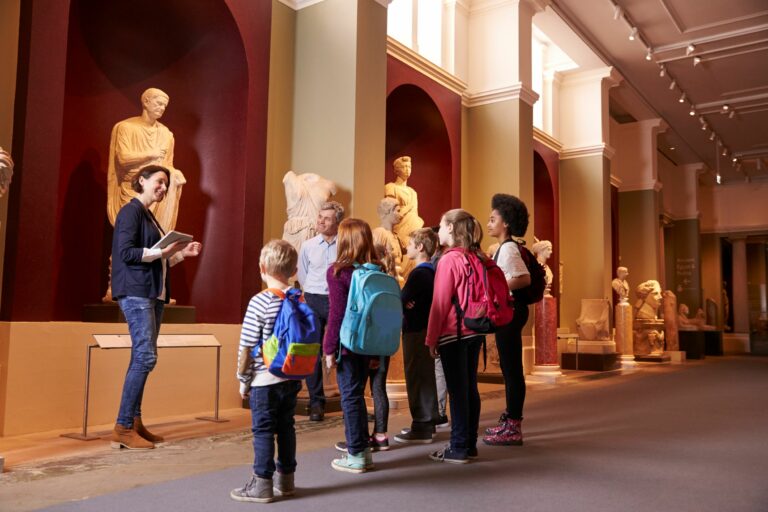
Pupils with their teacher on a guided tour in a museum
Today, anyone can ask an AI assistant to explain a painting, summarize the history of a monument, translate a museum label, or recommend artworks based on personal interests. Museums are increasingly adopting immersive technologies, interactive displays, virtual guides, and conversational AI to enrich visitors’ experiences. Tomorrow, many visitors may even arrive with their own AI agent, capable of answering almost any factual question instantly.
Faced with these rapid changes, an important question arises:
What will be the role of cultural mediators in the years to come?
Far from becoming obsolete, cultural mediation may become more essential than ever. But its purpose is evolving. The future is not about competing with artificial intelligence—it is about offering what technology cannot.
Information is no longer scarce
For centuries, mediators played a key role in making knowledge accessible. They explained artworks, historical events, scientific discoveries, and cultural heritage to audiences who often had limited access to information.
Today, information is abundant.
The challenge is no longer finding facts. It is understanding them, questioning them, and connecting them to our own experiences.
Artificial intelligence can provide answers within seconds. It can organise knowledge, personalise recommendations, and translate content into dozens of languages. These are extraordinary opportunities for accessibility and lifelong learning.
Yet information alone does not create understanding.
Understanding emerges through dialogue, curiosity, reflection, and shared experiences.
This is where cultural mediation becomes indispensable.
From transmitting knowledge to creating meaning
The cultural mediator of tomorrow is not simply someone who explains.
They create the conditions for people to observe, discuss, question, and interpret together.
Instead of delivering ready-made answers, they encourage participants to ask better questions.
Instead of speaking for visitors, they invite visitors to become active contributors.
Instead of presenting culture as something to consume, they help people build personal connections with heritage, art, science, and the stories that shape our societies.
In a world where knowledge is increasingly automated, meaning remains profoundly human.
The value of human interaction
Artificial intelligence can adapt information. It cannot genuinely understand the emotions, memories, doubts, or life experiences that every visitor brings into a museum or cultural space.
A skilled mediator notices hesitation, encourages participation, reassures someone who lacks confidence, and adapts the experience to the people in front of them :
- They create trust.
- They create dialogue.
- Most importantly, they create encounters between people.
These moments cannot be generated by algorithms alone.
Cultural mediation as a democratic practice
The challenges of the future are not only technological. They are also social.
We live in a world shaped by algorithms that constantly filter information, reinforce preferences, and personalise what we see. While these technologies offer remarkable possibilities, they can also reduce opportunities to encounter different perspectives.
Cultural institutions remain among the few public spaces where people from diverse backgrounds can meet around shared stories, objects, and places.
Here, mediation plays a vital civic role :
- It encourages critical thinking rather than passive consumption.
- It creates respectful dialogue across differences.
- It helps citizens explore complex issues without reducing them to simple answers.
- In this sense, cultural mediation is not only about heritage.
- It is about democracy.
Inclusion needs more than technology
Digital innovation is making culture more accessible than ever before. Automatic translation, easy-to-read content, audio description, subtitles, sign language interpretation, personalised pathways, and AI-assisted communication are opening doors for many audiences who have long been excluded. These developments should be celebrated. But accessibility is never purely technical.
Many people still need someone who welcomes them, listens to their concerns, adapts activities to their needs, and creates an environment where they feel confident enough to participate.
Technology can remove barriers. Human mediation creates belonging. Both are necessary.
The skills that matter tomorrow
As artificial intelligence continues to evolve, the skills required of cultural mediators are also changing.
Tomorrow’s professionals will need to combine cultural knowledge with facilitation, creativity, ethical reflection, digital literacy, inclusive communication, and intercultural dialogue.
Perhaps most importantly, they will need to help people navigate an increasingly complex world—not by giving them all the answers, but by helping them think together.
These are deeply human competencies:
- Empathy.
- Listening.
- Collaboration.
- Critical thinking.
- Creativity.
- The ability to build trust.
Far from becoming less valuable, these skills are becoming the foundation of meaningful cultural experiences.
Why young cultural mediators matter
This vision lies at the heart of the Mediate your Future! project. The project does not simply prepare young people to guide visitors through museums or heritage sites. It equips them to become facilitators, storytellers, community builders, and active citizens.
By designing inclusive cultural activities, working with diverse audiences, and connecting local heritage to contemporary issues, young mediators develop transferable skills that are increasingly relevant in every sector of society.
In an age where artificial intelligence can answer almost any question, helping people ask meaningful questions may become one of the most valuable skills of all.
Looking ahead
Artificial intelligence will continue to reshape museums, cultural institutions, and the way we experience heritage. It should be embraced as a powerful tool that expands access, supports inclusion, and enriches learning.
But technology alone cannot replace the human capacity to create dialogue, inspire curiosity, foster empathy, or strengthen communities. The future of cultural mediation is therefore not less human. It is more human than ever.
As information becomes increasingly automated, the role of the cultural mediator shifts from delivering knowledge to creating meaning.
And perhaps that is the role our societies need most.