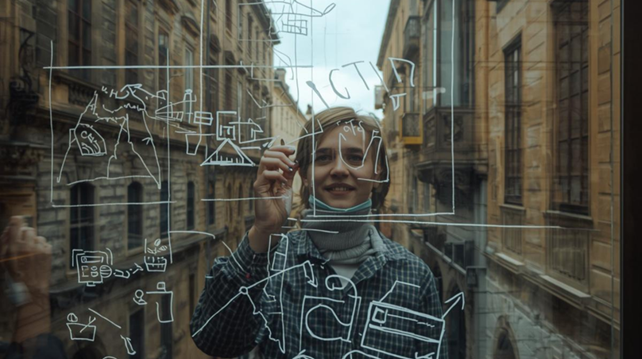
The reflection of a young man merges with historic buildings beyond a glass pane etched with diagrams, symbolising the planning of the future through urban memory, image generated by AI
Think of the last time you cooked a recipe handed down from your grandmother. Or the way your neighbourhood marks the arrival of spring with a ritual that nobody quite remembers the origin of, but everybody still shows up for. Or the dialect your grandparents speak, slowly fading as the younger generations move to cities. None of these things can be put behind glass in a museum. None of them appears on a UNESCO World Heritage list. And yet, all of them are heritage, living, breathing, irreplaceable.
This is what we mean by intangible cultural heritage: the practices, representations, expressions, knowledge and skills that communities recognise as part of their living culture. It is, by definition, unstable and dynamic. It changes with the people who carry it. And that is precisely what makes it so powerful.
More Than What We Preserve
For decades, the dominant model of cultural heritage work has revolved around preserving things — artefacts, buildings, sites. But as archaeologist Cornelius Holtorf has recently argued, many heritage professionals have already started to shift their focus, recognising that heritage is not primarily about the objects themselves, but about what they mean to people and, more importantly, what they enable people to do in society. A “people-centred approach,” he writes, allows heritage to play a more dynamic role, one “through which people engage with the past to make sense of the present and shape the future” (Holtorf, 2025).
Intangible heritage is, almost by definition, people-centred. It does not exist without the communities that practice and transmit it. Unlike a cathedral or an archaeological site, it cannot survive institutional protection alone – it survives only through use, through transmission, through the decision of each new generation to keep it alive or let it transform.
This is not a weakness. It is the source of its relevance.
A Living Form of Education
One of the most underappreciated dimensions of intangible cultural heritage is its intrinsic educational character. As UNESCO has argued, the intergenerational transmission of living heritage is itself “a dynamic, interactive process” and “a form of informal education that has been and continues to happen within communities” (UNESCO, n.d.). In other words, long before schools and curricula, communities were already teaching through stories, crafts, rituals, music, and oral traditions.
When this kind of knowledge enters formal or non-formal educational settings, something important happens. Learning becomes personally relevant. It ties in with students’ own worldviews, knowledge systems and imagination, making content more meaningful precisely because it is not abstract or distant – it is theirs (UNESCO, n.d.). This is especially significant for students from marginalised groups or vulnerable backgrounds, for whom mainstream educational content can feel alien or exclusionary.
Integrating intangible cultural heritage into education can also strengthen the connection between schools and local communities, “valorizing local knowledge and skills and raising the profile of community-based intangible cultural heritage” – with a ripple effect of building pride and re-engaging community members in the educational system “on shared terms of trust and cultural respect” (UNESCO, n.d.).
Heritage, Youth and the Future
The connection between heritage and the future is less obvious than it might seem, but it is crucial. As Morel and colleagues have argued, fostering “future consciousness” – the capacity to think proactively across time and anticipate change – is one of the most valuable contributions that heritage work can make to contemporary society (Morel et al., 2025). Heritage does not only tell us where we come from; when approached critically and creatively, it can help us imagine where we are going.
Holtorf makes a similar point in the context of global policy, arguing that cultural heritage “can build hope, solidarity and trust within communities, across borders and indeed between generations” – not because certain objects must be saved at all costs, but because remaining heritage can help us shape “a more sustainable future” (Holtorf, 2025).
For young people in particular – especially those at risk of disengagement from formal educational and civic structures – this reframing of heritage as something alive and useful can be transformative. Eurobarometer data consistently show that young Europeans care deeply about social issues such as inequality and climate change, yet feel increasingly disconnected from the institutions supposed to address them. Intangible cultural heritage offers a different entry point: local, tangible, personal. It is something young people can act on, not just contemplate.
What Mediate Your Future! Brings to the Table
Mediate Your Future! was designed with precisely this gap in mind. Rather than offering another top-down programme about heritage, it gives young people the skills and frameworks to become active mediators of their own cultural environment – to read, interpret and ultimately help transform the world around them.
The project’s approach is explicitly interdisciplinary, combining history, natural sciences, literature and other disciplines to help young participants see heritage not as a fixed inventory of protected sites, but as a living, contested and deeply relevant dimension of everyday life. This mirrors what UNESCO describes as teaching with intangible cultural heritage – using living culture not just as a subject of study, but as a lens through which to develop broader competencies and critical awareness (UNESCO, n.d.).
The skills developed through this kind of cultural mediation – critical thinking, communication, project management, problem-solving – are not soft extras. They are exactly what today’s labour market demands, and they are especially needed in the participating countries, where youth NEET rates (young people not in employment, education or training) range between 10% and 18%.
The project also produces practical resources: booklets and manuals with case studies and best practices, interdisciplinary mediation models, project planning templates, and a Europass-certified course. All of these are developed with a strong commitment to inclusivity and accessibility, recognising that young people with special learning disorders, disabilities or disadvantaged backgrounds face additional barriers – in cultural life and in the labour market alike.
Conclusion
Heritage is not just about what we preserve. It is about what we do with what we have inherited – the stories we choose to tell, the meanings we choose to activate, the communities we choose to build around shared memory and shared imagination.
Intangible heritage, in particular, lives or dies with the people who carry it. That makes it fragile. But it also makes it an extraordinarily powerful tool for education, civic engagement, and building the kind of future consciousness our moment demands (Morel et al., 2025).
Mediate Your Future! is a bet on the idea that young people, given the right tools and the right perspective, can become the most compelling custodians of that living heritage. Not guardians of monuments, but architects of meaning.
References
Holtorf, C. (2025, December 9). Culture and heritage matter to the world’s “Future Agenda.” United Nations University.
Morel, et al. (2025). Foresight in heritage: fostering future consciousness to proactively face change.
UNESCO. (n.d.). About living heritage and education.