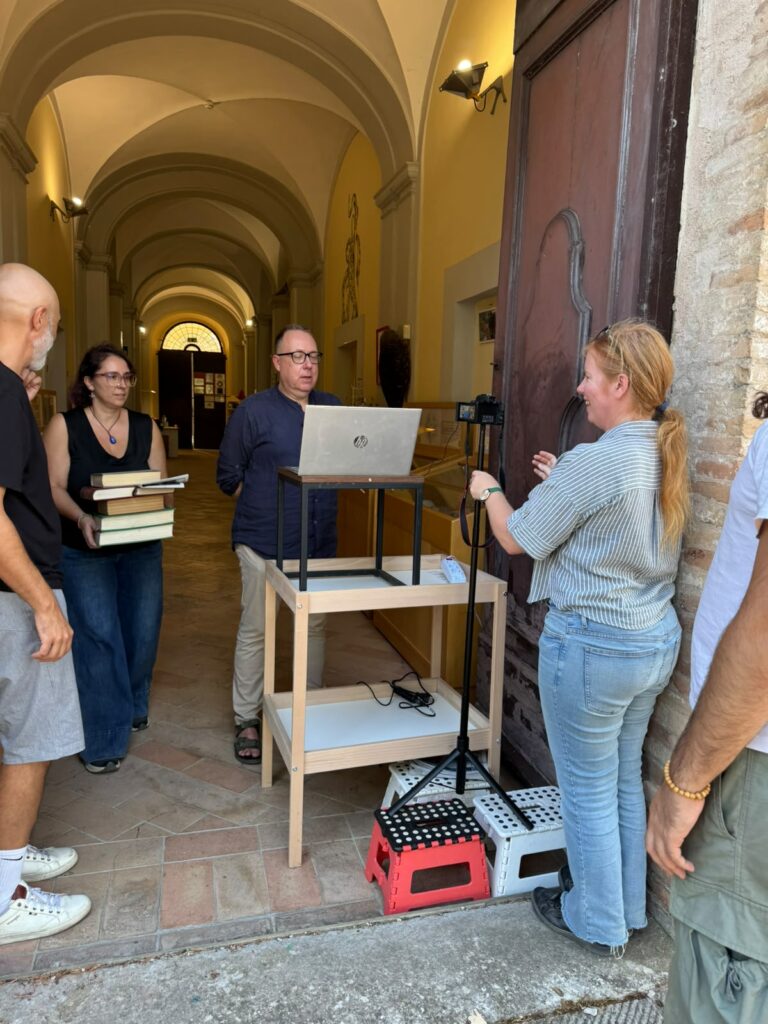
Preparing to videos recording, photo: Malakos Museum
What can you do when a young person has an idea but hesitates to speak up? How do you plan a walk for a group with different access needs? And what if the exhibition itself could travel to reach a new audience?
The five partners of the Erasmus+ project Mediate Your Future share their answers in a new series of videos. Filmed during our meeting in Città di Castello, the videos complement the project’s creation and adaptation modules. They’re for people who work with young people and want practical ways to adapt activities to their group, their local context or the resources they have.
Read the article: Behind the scenes of the filming in Città di Castello.
Fermat Science: Taking part without having to speak
During a postcard-making workshop in Mas-Grenier, Sandy Montcassin notices that several young people are reluctant to speak. She rearranges the room, offers picture cards so everyone can show how they feel, then invites one participant to take notes while another presents their card. The video shows how arranging the space and offering different roles can help young people join in at their own pace.
ELAN: Planning for accessibility from registration
How do you make a nature illustration workshop accessible to a group with varied needs? Ania Knapek starts with the registration form and suggests asking participants what adjustments they need. She then reviews the route with the workshop leaders. Where can people sit? Which stop could they move to avoid noise? When should they offer audio description or tactile materials? Her example shows how to make these decisions in advance while keeping the workshop focused on observing nature and creating something from what participants discover.
Les Expéditions: Telling a story when written text is a barrier
Camille Broch presents a wordless mural that uses pictograms to tell the story of Odysseus on the island of the Cyclopes. Participants can interpret the images, tell their own version and record it in their first language. The video also addresses a question that comes up in almost every workshop. How do you know whether people have understood an instruction? Asking someone to put it in their own words helps you spot what still needs clarifying and gives everyone another way to hear it.
ARTeria: Letting young people choose the topic and take the lead
At the barcamp in Matera, young people and the youth workers supporting them put the programme together. The heat they experience there makes discussions about climate change feel immediate. The young people use that experience to launch their own initiative, B.E.E. Active – Better Earth Education. Wenancjusz Ochmann explains the facilitator’s role at that point: spot an idea from the group, help it develop and give the group room to take it forward. He also discusses how difficult it can be to keep working together once everyone goes home.
Museo Malakos: Taking a sensory exhibition on the road
How can people who live far from a museum explore marine biodiversity? Debora Nucci presents modular chests that make it possible to take a sensory exhibition to a school, a library or a public square. Visitors can touch shells, look at details through a magnifying glass or listen to sounds of the sea. Depending on the venue, you can bring fewer stations, arrange them differently or change how you support visitors. The video helps you decide what to bring and how to set it up for the audience and venue.