
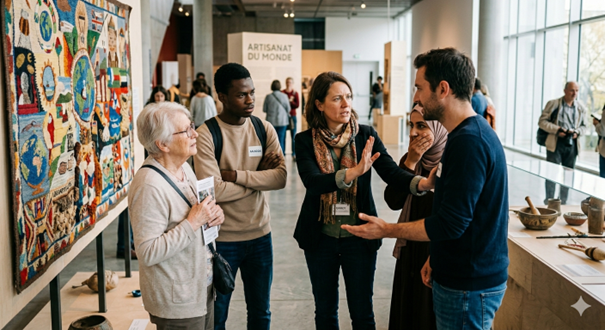
“The role of the cultural mediator is not limited to transmission; it also consists of welcoming disagreement and creating a safe space for dialogue.” (AI illustration).
In the clamour of disagreements, we often listen to respond rather than to understand. Yet, there is a powerful tool for defusing tensions: paraphrasing. Let’s take a closer look at this effective technique that transforms a dialogue of the deaf into a constructive exchange.
“That’s not what I meant!” We’ve all said or heard this phrase. In a cultural mediation project, conflicts don’t always arise from deep disagreement, but often from misunderstandings, differences in communication styles, or feelings of exclusion. In stressful or disagreeable situations, our brains distort messages. Words become projectiles, and the initial intention is lost in the emotional fog.
Contrary to popular belief, paraphrasing is not about mechanically repeating what the other person says like a parrot. It is an exercise in great precision. It involves rendering the other person’s thoughts in your own words, while removing any aggression from the discourse. It is a central tool for mediators to translate, soothe, and rebuild rapport.
Here’s why it’s absolutely crucial in this context:
- It diffuses the emotional charge
In conflict situations, words are often driven by anger, frustration, or fear. The mediator listens to this outpouring, but when it comes to reformulating, they apply a filter. They separate the “grain” (the real need, the facts) from the “chaff” (the insults, the accusations, the generalisations). By presenting this clarified image, the mediator allows the other person to hear their own arguments, free from aggression; they feel understood, while the opposing party can finally listen to the core message without feeling attacked. This often leads to immediate realisation.
- It translates “cultural codes” and bridges language gaps
Cultural mediation often involves very diverse audiences (institutions, artists, local residents, minorities). Each group uses its own jargon or references. A word that is innocuous to one person can be perceived as condescending by another, and vice versa. By reformulating, the mediator acts as a translator. They will rephrase expectations using each person’s own words to ensure that everyone is speaking the same language.
- It validates the feeling of being heard
A key element of a successful cultural project is inclusion. Conflict often arises when an individual or group feels their voice, story, or identity is being ignored.
For example, saying, “If I understand you correctly, what’s essential for you is that…” demonstrates active listening.
This explicit acknowledgement reduces defensive barriers. Once people feel validated in their experiences, they are ready to engage in dialogue again.
- Finally, it objectifies the debate and validates the points of agreement.
In the midst of an argument, we tend to believe that we disagree on everything. Rephrasing helps to sort things out.
- Isolate the real problem and validate the other person’s emotions: distinguish a technical issue (e.g., workshop schedule) from a symbolic one (e.g., perceived lack of respect). By paraphrasing, you tell the other person, “I heard you.” This simple signal lowers their cortisol levels (the stress hormone).
- Highlight areas of agreement: show that, despite the way things are presented, both parties often share the same underlying objective (e.g., the project’s success for the neighbourhood).
- Set the next steps: validate the resolved points one by one to solidify the discussion’s progress.
How to practice reformulation?
Here are three types of reformulations to try during an upcoming meeting or discussion:
The summary (to clarify): “To sum up, your two priorities are meeting deadlines and the quality of the final product.”
The clarification (to delve deeper): “It seems that behind your anger, there’s primarily significant fatigue related to the workload.”
The reflection (to encourage): “You feel like you’ve tried everything without success.”
Ego in the closet
The greatest difficulty in this exercise isn’t technical; it’s psychological. Practising paraphrasing requires setting aside your own ego. You have to accept, for a few minutes, not giving your opinion, not judging, and not trying to be right.
It is only at this price that dialogue can be reborn. By becoming the other person’s mirror, you don’t necessarily agree with them: you give them the opportunity to be understood. And it is often there that calming down begins.
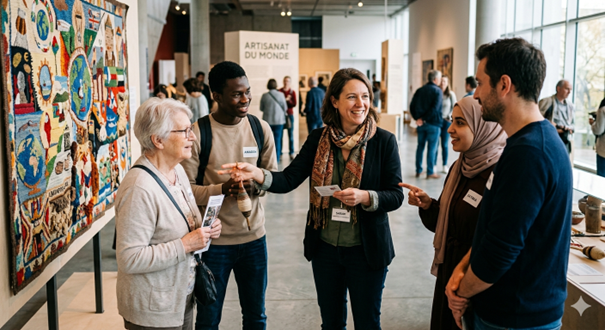
Cultural mediation – Creating connections, sparking curiosity, and fostering harmony among audiences from diverse backgrounds
Develop universal "Soft Skills" through the Mediate Your Future project!
Beyond the figure of the professional mediator, “Mediate Your Future” aims to instil a culture of mediation in civil society. By following the training program and using the tools provided, you will also develop highly sought-after transferable skills in the job market:
- Emotional intelligence: knowing how to identify and accept one’s own emotions as well as those of others.
- Critical thinking: learning to analyse a situation from multiple perspectives before acting.
- Collaborative leadership: knowing how to unite opposing parties around a common goal.
Looking to enhance your mediation skills? Find all our tools and training courses on the Mediate Your Future portal.